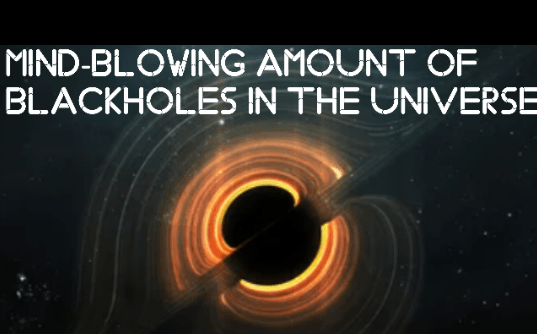
The Brain Blowing Measure Of Dark Openings In The Universe.
Dark openings were first anticipated by Einstein’s hypothesis of general relativity which expresses that mass genuinely affects the actual texture of spacetime — the unified three elements of room and one of time.Before general relativity, researchers had seen space as basically the stage whereupon the occasions of the Universe work out. Einstein refined this, space turned into a player in an extraordinary enormous creation.
Out in the profundities of room there prowl stowed away beasts — dark openings — which are the densest items known to man. They can be difficult to detect on the grounds that they ingest all that which comes excessively near them, including light. So we aren’t quite certain the number of them really exist known to mankind — however specialists as of late thought of a gauge. In a paper distributed in The Astrophysical Diary, a gathering of scientists from Italy and the UK utilized a recreation called SEVN, or Heavenly Development N-body code, to gauge how much mass in worlds comprised of stars. By utilizing information about the pace of star development and the arrangement of the space between cosmic systems, called the interstellar medium, the gathering determined the amount of the mass of worlds could be made sense of by these elements. From this, they could figure out how much mass is “covered up” in dark openings. The exploration recommends that dark openings could be liable for an enormous lump of the mass of systems, with around 1% of the mass of common matter being tracked down in dark openings. That would mean the universe would have a huge number of dark openings — around 40 billion billions, or 40 followed by 18 zeroes altogether. Getting to this gauge took various specialists in various fields cooperating, as one of the scientists, Andrea Lapi of the Scuola Internazionale Superiore di Studi Avanzati (SISSA) or Worldwide School for Cutting edge Examinations, made sense of: “This exploration is truly multidisciplinary, covering parts of, and requiring mastery in heavenly astronomy, system development and development, gravitational wave and multi-courier astronomy; as such it needs cooperative endeavors from different individuals from the SISSA Astronomy and Cosmology bunch, and a solid systems administration with outside colleagues.” It is possible that dark openings make up a critical lump of the mass of the universe, alongside stars, and the residue and gas that is normal both inside worlds and between them in the interstellar medium. However, you could have seen that this outcome demonstrated the way that dark openings could make up 1% of customary matter. That is on the grounds that common matter, or what physicists call baryonic matter, is itself simply a little piece of the complete mass of the universe. All that we see around us — each article, each molecule — makes up under 5% of the complete of all that exists known to man. The remainder of the mass is comprised of dull matter and dim energy. Precariously, that we can’t straightforwardly notice dull matter or dim energy. We realize that they should exist since we can see their belongings, yet nobody has at any point prevailed in straightforwardly identifying them. So they are hypothetical develops, however ones most cosmologists are almost certain should exist. Dim matter is the name for a hypothetical molecule that makes up around 27% of the universe. At the point when you take a gander at exceptionally huge items like cosmic systems, the way that they move proposes they have significantly greater gravity, and subsequently much more mass, than is noticeable to us. This inconspicuous mass is called dim matter.
Dull energy is a hypothetical type of energy that we think should exist because of the manner in which the universe extends. Researchers have realized that the universe is extending for quite a long time, yet estimations utilizing the Hubble Space Telescope during the 1990s showed it was growing surprisingly quick. The additional energy pushing this development is called dim energy, and it makes up an inconceivable 68% of the complete universe.
- “Mercury and the Sun Unite: Witness the Rare Solar Conjunction on Feb 28, 2024!” AstroPhel007
- “Mystical Alignment: Witness the Rare Venus-Pluto Conjunction on February 20th, 2024! AstroPhel007
- The Upcoming Astronomical Event Aphelion Sun-Comet 2021S PanStars On 14th Feb 2024 | AstroPhel007
- The Upcoming Astronomical Event New Moon 10th Feb 2024 | Astrophel007.
- The Upcoming Astronomical Event Occultation Of Moon-Antaries 5th Feb 2024 | Astrophel007 |
 AstroPhel007
Mind blowing
LikeLike
Amazing person
LikeLike
😲🤩😍
LikeLike
Nice
LikeLike
Amazing
LikeLike